Hello world, long time no see.
I have returned! To talk about some birds (you are in a crow’s lair after all…), and there are a lot of them in the CFA world, especially in the options area.
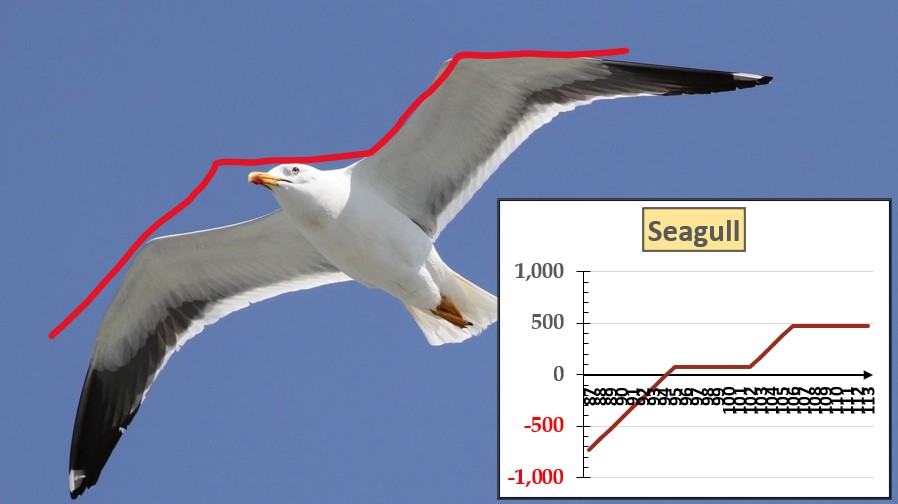
Today we are going to talk about Seagulls, and I will make this topic so easy to follow, learn, and remember, you can’t even imagine. No one has seen anything like that!
Are you hyped? Not enough. Have some more, and let’s go!
First of all, tell me – do you know these strategies below?
- long call
- long put
- short put
- short call
Sure you do.
– Can you tell me which of these are long, and which ones are short?
(Not that it’s in the name, but anyway.)
– Can you tell me which of these are bullish, and which ones are bearish? Now we talkin’!
You have to remember – not everything long or call is bullish. Short Put is bullish too!
How do we know? (bullish or bearish)
- DELTA!
Puts have negative delta. If we short that, we have two negative signs = positive delta.
Got it? - (Un)limited risk/potential – If your upside is potential (whether capped or not) and your downside is risk, that’s clearly bullish.
- Capped upside potential + unlimited downside risk = bullish (e.g. short put or bullish short seagull).
- Unlimited upside potential + limited downside risk = bullish (e.g. long call or bullish long seagull).
- Capped upside RISK+ unlimited downside POTENTIAL = bearish (e.g. long put or bearish long seagull).
- Unlimited upside RISK+ limited downside POTENTIAL = bearish (e.g. short call or bearish short seagull).
Other variants – both capped or both unlimited (whether upside or downside, potential or risk) – are mixed and can be bearish, bullish, or neutral.
- Both (upside and downside) unlimited risk – short strangle or short straddle.
- Both unlimited potential – long strangle or long straddle.
- Both limited risk – short butterfly or short condor.
- Both limited potential – long butterfly or long condor.
These are delta-neutral (if ATM), and can be bearish or bullish (if not ATM) – e.g. short straddle below spot is bearish. Also, these are symmetrical strategies.
Seagulls are not delta-neutral and not symmetrical.
Seagulls have delta exposure and are directional.
Now look at the similarities and tell me which of those are long/short and bullish/bearish.
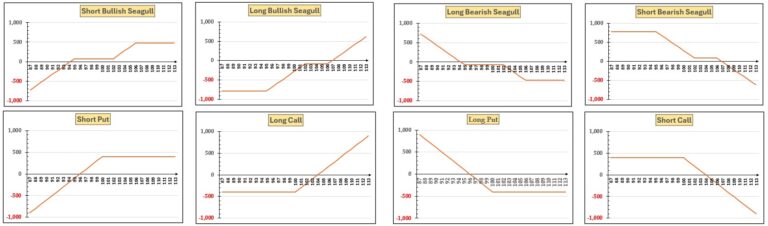
These are all 4 shapes of seagull.
That was easy, isn’t it?
Do we tell whether a seagull is short or long only because of similarities to LC/LP/SC/SP?
No, not really. That’s your anchor to remember.
The rule is a bit different.
(There’s no strict rule, to be honest. Just look at options strategy names – Seagull, Poor Man’s CC, Iron Butterfly – it’s just jargon.)
The rule is much closer to (un)limited risk/potential.
You can look at a seagull as Bull Spread + LC/SP or Bear Spread + LP/SC.
- Bull/Bear Spread is always built from one short and one long option – both net each other out.
- +LC/LP/SC/SP – it’s clear, right?
If you add LC to a bull spread (LC must be higher than the bull spread), you have a LONG bullish seagull. You are long 2 options and short 1.
What you CAN’T do. (You can, but it won’t be a seagull.)
- You cannot add LP/SC to Bull Spread or LC/SP to Bear Spread. You would make your seagull neutral. That’s not the point of that strategy – a seagull must be consistent.
- The spread cannot be in the (non-neutral range of) LC/LP/SC/SP. E.g. LC must be higher than the bull spread. SP must be lower than the bull spread. You got it?
Why do we use Seagull?
Seagulls are great and not that complicated, trust me. I started with a seagull and didn’t even know the name at that time – and I came up with that strategy myself.
My logic was: I have no problem buying that stock lower, but I want something more than just short put premium if it skyrockets. Also, if the stock price stays between the bull spread and short put, I want to earn at least the risk-free rate for waiting. You can get that bull spread “for free” (by taking on the risk).
Can you tell me which seagull I’ve just described?
You must understand this, you can’t just memorize it, if you want to solve CFA exam problems.
E.g. where is BEP in a bullish long seagull?
It can be lower than the short put strike or within the bull spread.
Use an options calculator, look at the stock’s chart, try to simulate your plan, and apply the seagull strategy. Learn by practice!
16 shadows of Seagull
You can create a seagull in 16 different ways. I’m not kidding. It’s possible.
- There are 4 shapes of seagulls – that’s 4 ways already.
- Within each seagull, there’s a spread. You can create a spread in 2 different ways (e.g. bull spread can be built with two puts or two calls) – that gives us 2x, so 8 ways already.
- Each seagull can be created with another seagull by adding Long Stock or Short Stock. That other seagull can itself be created on 2 ways, right? That’s another multiplication by 2, so 16 ways to create a Seagull!
Let’s look a bit closer on point 3.
- You can create a BULLISH seagull by adding LONG stock (that’s bullish) to a BEARISH seagull.
Long/short in seagull’s name stays the same.
E.g. Short BEARISH seagull + LONG stock = short BULLISH seagull. - You can create a BEARISH seagull by adding SHORT stock (that’s bearish) to a BULLISH seagull.
Let me know if any questions! Happy to help!
Join the Conversation
I encourage you to engage with this series by liking the posts and sharing them with your fellow CFA candidates. Your participation helps create a vibrant learning community where we can all benefit from shared knowledge and experiences.
Stay tuned for the next article where we’ll begin our exploration of specific options trading strategies. Whether you’re just starting or looking to refine your skills, this series is your gateway to mastering options trading.